Quarters, Classics, and Conviction: The Jacksonville Dive Bar That Never Plugged Into the Stream
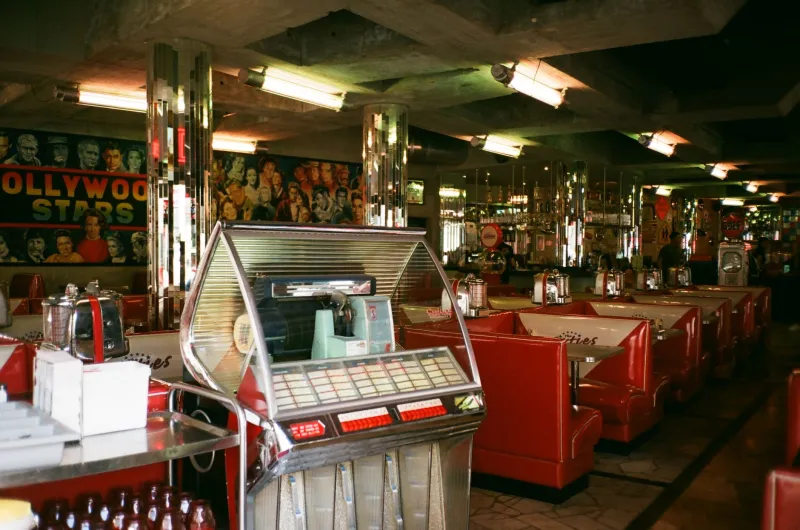
There's a bar on the Westside of Jacksonville — the kind with a screen door that slaps behind you, a concrete floor that's seen better decades, and a Budweiser clock on the wall that hasn't kept accurate time since the Clinton administration — where a Wurlitzer jukebox still stands in the corner like it owns the place. Because, in a very real sense, it does.
While the rest of the city's drinking establishments were busy swapping out their physical machines for TouchTunes tablets and Spotify-powered speaker systems, the owner of this particular joint — we'll call him Denny, because that's what everybody calls him — looked at the offers, looked at his regulars, and said no. Just flat out no.
"They kept sending guys in here telling me I could have ten million songs for thirty bucks a month," Denny says, leaning against the bar with his arms crossed like a man who's had this conversation too many times. "And I kept telling them the same thing: I don't want ten million songs. I want the right two hundred."
The Machine That Time Forgot — On Purpose
The jukebox in question is a Wurlitzer 1800 series, fully restored and loaded with 45s that Denny has curated himself over the better part of thirty years. Merle Haggard. Tammy Wynette. George Jones. Waylon Jennings. Conway Twitty. Johnny Paycheck. A few Willie Nelson cuts that Denny says he added "reluctantly, but the man earned it." There's a handwritten index card taped to the side listing the selections by number, because the original label holder cracked sometime in the mid-nineties and Denny never got around to replacing it.
It costs fifty cents a play. Three songs for a dollar. Same as it's been since he took over the place.
The machine gets serviced once a year by a guy named Earl who drives down from Valdosta specifically to keep it running. Earl is 71 years old. Denny has already started quietly worrying about what happens when Earl can't make the drive anymore, but he pushes that thought aside the way you push away anything you can't fix right now.
"That jukebox breaks down for good, I don't know what I do," he admits. "But it hasn't yet."
The Regulars Know the Numbers by Heart
On any given Thursday night, the bar fills up with the kind of crowd that doesn't need to read the index card. They know the numbers. B-7 is "If We Make It Through December." C-3 is "He Stopped Loving Her Today." F-12 — the most-played selection in the machine, according to Denny's informal mental tally — is Waylon's "Are You Sure Hank Done It This Way."
There's a retired pipe fitter named Gerald who comes in every Friday at five-thirty and spends the first two dollars of his evening feeding the jukebox before he even orders a drink. He's been doing it for eleven years. Ask him why he comes here instead of one of the newer places with the big screens and the digital systems, and he'll give you a look like you just asked him why he breathes.
"Because I know what's gonna come out of that thing," Gerald says. "Over there at those other places, you don't know. Could be anything. Could be something that sounds like country but isn't. Here, it's always gonna be real."
That word — real — comes up again and again when you talk to the regulars. It's not just about the music itself, though the music matters enormously. It's about the intentionality of the whole experience. Someone had to physically pick up that record. Someone had to decide it was worth keeping. Someone had to walk up to a machine, put money in, and choose. There's a chain of human decisions connecting every note that comes out of those speakers, and the people in this bar can feel it.
Analog Resistance as Cultural Preservation
What Denny is doing — whether he'd describe it this way or not — is an act of preservation. Not the museum kind, where things get roped off and labeled. The living kind, where something continues to function the way it was always meant to function, in the context it was always meant to exist in.
Streaming platforms have done a lot of good things for music access, but they've also done something quietly corrosive to the listening experience: they've made curation feel optional. When everything is available, nothing feels chosen. When a playlist can contain ten thousand songs, no individual song carries the weight of having been selected over something else.
A jukebox with two hundred 45s doesn't have that problem. Every single record in that machine got there because somebody thought it deserved to be there. And every time a regular drops in fifty cents and punches a number, they're participating in a ritual that connects them to every other person who's ever stood in front of that machine and made the same choice.
Denny doesn't talk about it in those terms. He'd probably roll his eyes if you did. But he does say this: "People come in here stressed out, beat up from the week, whatever. They walk over to that jukebox, they look at what's in there, they pick something — and I watch 'em settle down. Every time. Something about it just settles people down."
What Gets Lost When the Machine Goes Dark
It's worth asking what exactly disappears when a bar like this eventually gives in — when the Wurlitzer finally can't be fixed, or when Denny retires, or when the rent goes up and the math stops working. Because something does disappear, and it's not just the music.
It's the ritual of choosing. It's the social negotiation of a shared listening space — the way two strangers at a bar can bond over a song selection, or debate the next one, or respectfully disagree about whether Conway Twitty belongs in the same conversation as George Jones. (He does. Don't argue with Denny about this.)
It's the physical presence of the music itself — the fact that there's an actual object in the room, something with weight and history, that's producing the sound. You can't see a Spotify playlist. You can see a Wurlitzer 1800 from across the room, and it looks exactly like what it is: a thing that was built to last, by people who believed the music it carried was worth building something lasting for.
Still Standing
Last time we checked in, the jukebox was working fine. Earl had been down in the spring and given it a clean bill of health. F-12 was still the most-played selection. Gerald was still coming in on Fridays at five-thirty.
And Denny was still saying no to the guys with the tablets.
In a city that's changing fast — new development, new venues, new sounds bleeding in from every direction — there's something genuinely valuable about a place that knows exactly what it is and refuses to be talked out of it. Jacksonville's always had that stubborn streak. It's one of the things that makes this town worth writing about.
The jukebox is still standing. Long may it play.